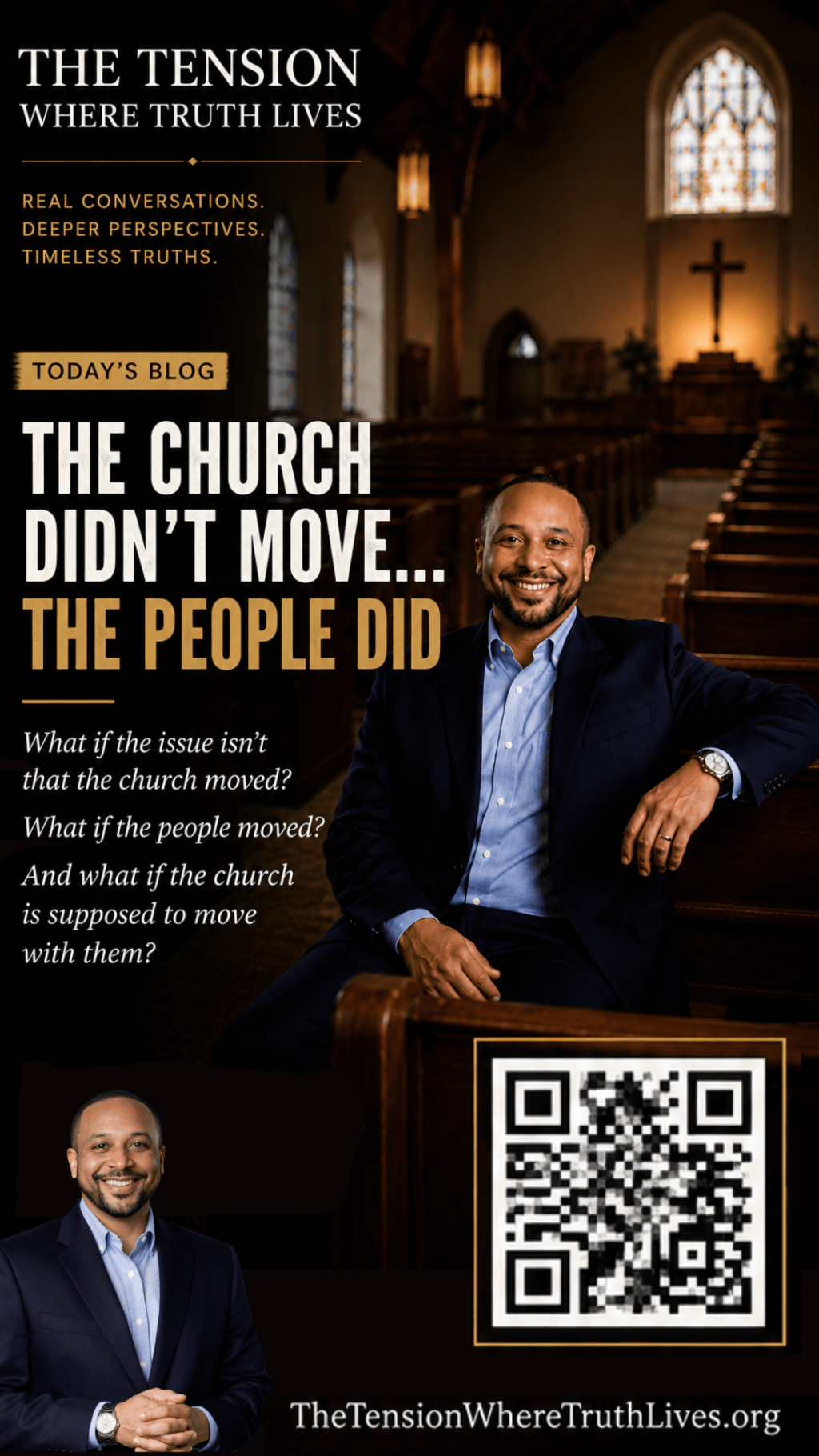
For the last several years, I’ve heard the same question asked in countless churches, conferences, leadership meetings, and pastor gatherings.
“How do we get people back to church?”
It’s an understandable question.
Attendance patterns changed.
Habits changed.
Technology changed.
COVID accelerated changes that were already taking place.
And many churches have spent the last few years trying to figure out how to bring people back to what once was.
The longer I think about it, the more I wonder if we’re asking the wrong question.
What if the issue isn’t that the church moved?
What if the people moved?
For much of my life, if people wanted to hear a sermon, attend Bible study, participate in worship, or engage in a faith conversation, they generally had to go where it was happening. The church building occupied a unique place in the community. It wasn’t simply a place of worship. It was often a gathering place, a cultural center, and a source of information, connection, and support.
Then the world began to change.
Television expanded the room.
The internet expanded the room again.
Social media expanded it even further.
Then COVID compressed years of change into a matter of months.
People learned how to work from home.
Shop from home.
Meet from home.
Learn from home.
And yes… worship from home.
The world changed.
The people moved.
But here’s the tension I’ve been wrestling with.
The church has always moved.
Long before there were church buildings, there was a church.
The church met in homes.
The church met beside rivers.
The church met in marketplaces.
The church met in borrowed rooms.
The church met in prisons.
The church met wherever God’s people happened to be.
The church was never primarily a building.
The church was always people.
Which means if the people move, perhaps the church is supposed to move with them.
Now before somebody misunderstands me, I’m not suggesting that local churches no longer matter.
I pastor a local church.
I believe people need community.
People need relationships.
People need accountability.
People need somebody to pray with them in a hospital room, stand beside them during a funeral, and celebrate with them during life’s victories.
A podcast can’t do all of that.
A YouTube channel can’t do all of that.
A Facebook Reel can’t do all of that.
But they can do something.
They can open a door.
That realization hit me recently as I thought about ministries that have experienced remarkable growth over the years. Here in Nashville, one of the most notable examples is Mount Zion. Over several decades, growth created a new challenge. How do you continue reaching people when the room is no longer large enough? The answer eventually became additional locations. More campuses. More places where people could connect.
It was a practical response to a growing audience.
But technology has introduced another layer to that conversation.
Today, a person can listen to a pastor while driving to work.
They can hear a message while exercising.
They can watch a conversation at midnight from the other side of the country.
Geography is no longer the barrier it once was.
Which raises an interesting question.
If previous generations expanded by building bigger rooms, what if this generation must expand by building longer tables?
That’s how I’ve started thinking about podcasts.
Not as replacements for churches.
Not as competitors to churches.
Not as substitutes for churches.
But as longer tables.
Places where people can pull up a chair from wherever they happen to be.
A truck stop.
A hospital room.
A prison cell.
A college dorm.
A shelter.
A living room.
A night shift.
A lonely drive home.
The conversation begins wherever they are.
That’s why I believe the opportunity in front of us is larger than attendance.
It’s larger than technology.
It’s larger than platforms.
The real question is whether we are committed to the message or merely committed to the methods that once carried the message.
Because methods have always changed.
The message remains.
The mission remains.
People remain.
And wherever people go, the Gospel still belongs there.
Perhaps that’s the lesson for our generation.
The building didn’t move.
The people did.
And maybe the next great challenge is not figuring out how to get people back to where they used to be.
Maybe it’s learning how to faithfully meet them where they are.
Because if the church is truly people…
Then wherever the people are…
The mission field is there too.
And maybe…
Just maybe…
That’s where truth has been living all along.
In the tension.
— Pastor Charles E. Howse Jr.
 The Tension Where Truth Lives
Leave a comment