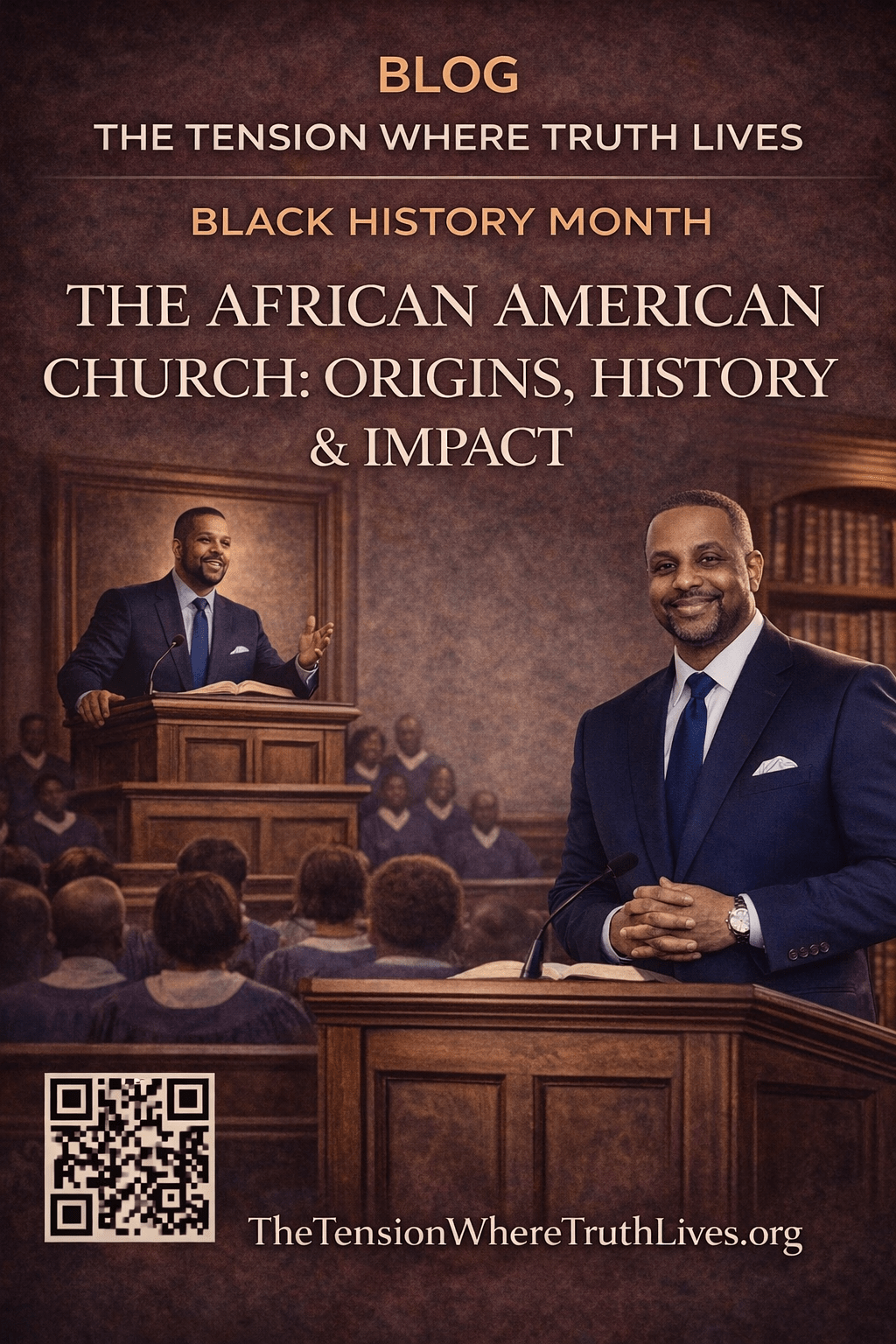
The African-American church was never just a place to worship.
It was born out of necessity, sustained by faith, and forged under pressure.
Long before it had steeples or stained glass, the Black church existed as a gathering of people who were denied dignity everywhere else. When laws dehumanized, when systems excluded, when voices were silenced—the church became the one space where Black humanity could breathe.
It did not begin as a cultural preference.
It began as survival.
In the earliest days, enslaved Africans were often prohibited from worshiping freely. When they were allowed to gather, it was usually under supervision, with Scripture filtered to reinforce obedience rather than hope. But faith has a way of escaping containment. What was meant to control became a source of strength. What was intended to silence became a language of resistance.
The Black church learned early how to read the Bible from the underside of history.
Stories of Exodus, deliverance, suffering, and promise were not abstract theology—they were lived reality. Faith was not theoretical. It was embodied. It had to be.
Over time, the African-American church became more than a spiritual refuge. It became a school when education was denied. A bank when financial systems excluded. A meeting hall when public space was unsafe. A counseling center when trauma had no other outlet. A training ground for leadership when opportunity was blocked elsewhere.
It taught people how to stand, speak, organize, and hope.
And most importantly, it taught people that their lives mattered.
The Black church produced preachers, yes—but it also produced teachers, organizers, thinkers, artists, caregivers, and leaders whose influence stretched far beyond Sunday morning. It cultivated a theology that held together suffering and hope, realism and promise, lament and praise—without denying any of them.
That balance mattered.
Because the African-American experience has always lived in tension: joy and grief, faith and frustration, endurance and expectation. The church did not pretend those tensions didn’t exist. It gave them language. It gave them rhythm. It gave them song.
Even today, the impact remains.
The Black church continues to shape conscience, form community, and preserve memory. It reminds us where we’ve been, even as it wrestles with where we’re going. It carries the stories that textbooks overlook and the wisdom that cannot be reduced to slogans.
It has not been perfect. No institution formed by human hands ever is. But it has been faithful—again and again—when faithfulness was costly.
To speak of Black history without the Black church is to tell an incomplete story.
Because the church was not just a witness to history.
It was a participant in it.
And its legacy is not simply what it built—but what it sustained: dignity, resilience, voice, and hope.
Pastor Charles E. Howse Jr
Beth-El Baptist Church
 The Tension Where Truth Lives
Leave a comment