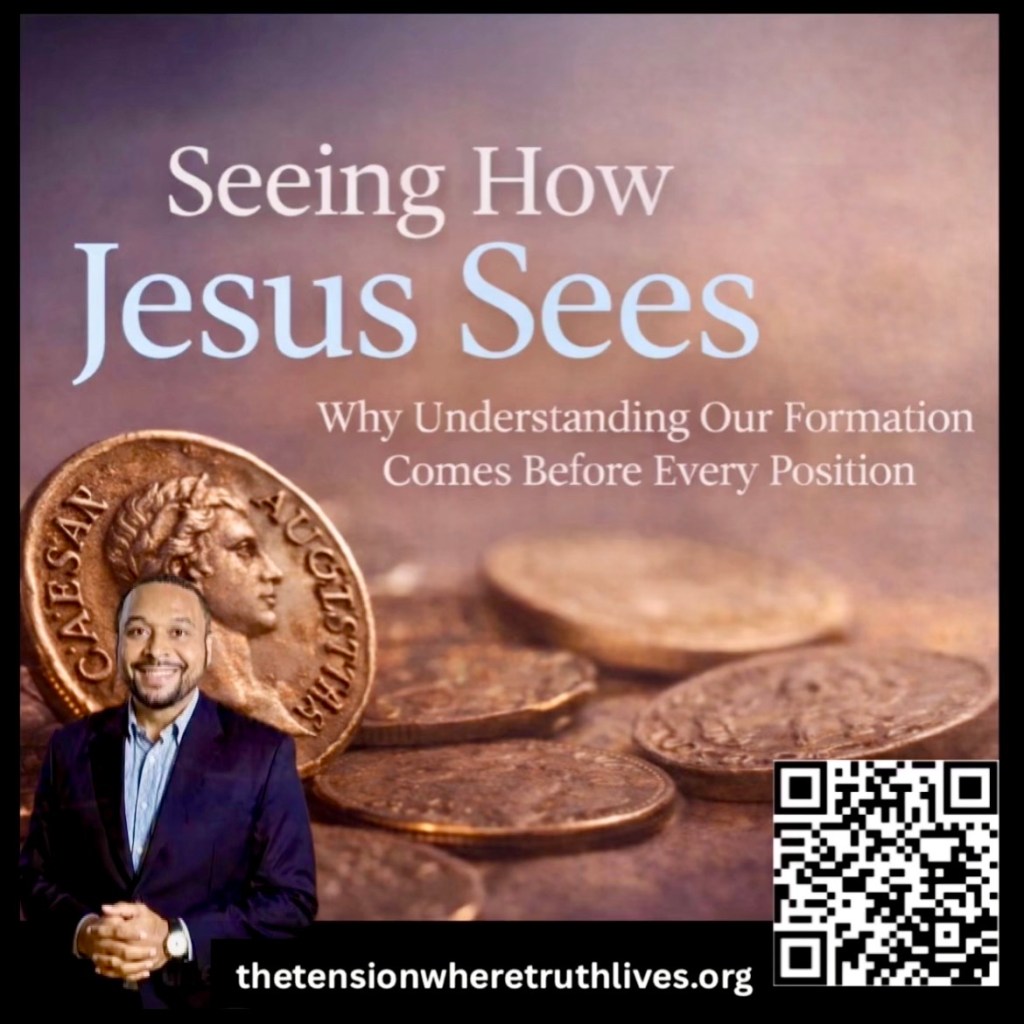
Seeing How Jesus Sees
Why Understanding Our Formation Comes Before Every Position
There are moments in Scripture where the question being asked is not the question that truly matters.
The passage where Jesus is asked whether it is lawful to pay taxes to Caesar is one of those moments. On the surface, it sounds like a political question — a matter of policy, loyalty, and obligation. But the longer I have sat with this text, the more convinced I’ve become that Jesus was not responding to policy at all.
He was discerning something deeper.
He was discerning how the people in front of Him had been shaped to see the world.
Before going further, it’s important to slow down here. If we rush past this passage, Jesus’ response can sound clever or evasive. If we pause, it becomes something else entirely — an invitation to examine how perspective is formed long before opinions are expressed.
Most of our disagreements today, both inside and outside the Church, are not really about theology, politics, or morality. They are about how we see. And how we see is rarely neutral.
When I use the word formation, I’m not referring to academic theory or psychological language. I’m speaking about the quiet shaping that happens over time — often without our awareness.
Formation is what felt normal before we ever questioned it.
It is what trained our instincts before we chose our beliefs.
It is what taught us who to trust, what to fear, and what to protect.
Much of this shaping happens before theology ever enters the room.
That’s why two people can read the same Scripture, hear the same sermon, and walk away with completely different conclusions — not because one is faithful and the other is not, but because they are starting from different places.
When the religious leaders approached Jesus about paying taxes to Caesar, they were not seeking wisdom. They were seeking leverage.
If Jesus affirmed paying taxes, He would appear loyal to Rome.
If He rejected it, He could be accused of rebellion.
Either response would force Him into a camp.
Jesus refused the framework altogether.
Instead of choosing a side, He reframed the question. He asked for a coin and then posed a simple but penetrating question: “Whose image is on it?”
That question changed everything.
This was never really about money.
Jesus was not denying Caesar’s authority, but He was also refusing to let Caesar define ultimate allegiance. He redirected the conversation away from policy and toward identity.
In effect, Jesus was saying: You’re arguing about what you owe the system, but you haven’t stopped to consider who you belong to.
That shift matters.
It reveals how Jesus sees — calmly, clearly, and without being trapped by the options placed in front of Him. He does not answer from fear or reaction. He does not live inside extremes. He sees from a place of clarity shaped by His relationship with the Father.
This is what Scripture means when it speaks of the mind of Christ.
I’ve come to believe that many of our most entrenched debates persist because we skip this step. We argue conclusions without ever examining starting points. We defend positions without acknowledging the experiences that shaped them.
When formation goes unexamined, certainty feels like faith, disagreement feels like threat, and tension feels like failure.
Jesus models another way.
He shows us that tension does not have to be resolved quickly to be handled faithfully. It can be held carefully — long enough for truth to surface without force or fear.
Before moving deeper into this passage, or into any difficult conversation, there is a quieter question worth asking ourselves:
What has shaped the way I see — that I’ve never slowed down long enough to examine?
That question doesn’t accuse.
It invites.
And when we begin there, Jesus’ words no longer sound evasive. They sound clarifying.
“Render to Caesar what belongs to Caesar, and to God what belongs to God.”
Not compromise.
Not avoidance.
But perspective.
What stays with me most in this passage is not just the brilliance of Jesus’ response, but the way He saw the people standing in front of Him.
He saw their question, but He also saw what shaped it.
He heard their words, but He understood the formation beneath them.
He recognized the pressure they were under and the lenses through which they were seeing the world.
Jesus did not shame them.
He did not dismiss them.
And He did not argue on their terms.
He saw them.
And in seeing them so clearly, He invited them into a deeper kind of sight.
Jesus sees us in the same way — not only what we say, but how we’ve been shaped to say it. He sees the histories, fears, loyalties, and instincts that quietly influence how we approach every conversation.
But His desire is not merely that we be seen.
His desire is that we learn to see ourselves.
To recognize the formation we carry.
To notice the assumptions we bring.
To understand how our experiences shape our reactions long before we call them convictions.
Not so we can condemn ourselves — but so we can be free.
Jesus saw them.
Jesus sees us.
And in that seeing, He invites us into the kind of clarity that makes room for truth — not shouted, but understood.
That is where this conversation begins.
 The Tension Where Truth Lives
Leave a comment