What a Moment Taught Me That a Movement Couldn’t
Some of the most sincere language in the Church has been spoken in the name of reconciliation.
I’ve heard it preached passionately.
I’ve watched it taught earnestly.
I’ve seen it celebrated publicly.
And I believe much of it was genuine.
But over time, I’ve learned something that has stayed with me: reconciliation language can move faster than formation. And when it does, it exposes a gap we are often not prepared to face.
⸻
In my early twenties, I encountered a group of charismatic white Christians who were deeply kind to me. They invested in me, encouraged me, and extended generosity that I never took lightly.
At one point, they paid for me to attend a large men’s gathering that was popular at the time. Its stated focus was reconciliation — restoring men to their place in God, walking in integrity, confronting past conflicts, and learning how to ask for forgiveness when necessary.
The language was right.
The intentions were sincere.
The atmosphere was powerful.
Then came a moment that stayed with me.
⸻
It was the day the verdict in the O.J. Simpson trial was announced. The nation was tense. Emotions were raw. Everyone seemed to be carrying something just beneath the surface.
Shortly after the verdict, I ran into one of the men who had been so kind to me — someone who had helped make it possible for me to attend that gathering.
In a moment charged with emotion, he said to me,
“That’s the problem with you people…”
I stopped him immediately.
“You people?” I asked. “What do you mean you people?”
What followed wasn’t a conversation. It was a reaction — an emotional release shaped by fear, frustration, and cultural pressure.
I understand now what I couldn’t fully articulate then. His words were not created in that moment. They were revealed by it.
⸻
Even as a young preacher, something in me recognized what I was witnessing.
This wasn’t simply about a person failing to live up to a message.
It was about formation that had never been addressed.
Reconciliation language had been learned.
But reconciliation formation had not yet taken root.
⸻
What I came to understand — slowly and carefully — is that conferences, movements, and emotional moments cannot, by themselves, uproot what has been shaped in the spirit, the soul, and the psyche over generations.
Some things require more than agreement.
They require excavation.
Some beliefs survive worship untouched.
Some assumptions remain intact even after confession.
And when formation is bypassed, reconciliation becomes fragile — easily undone by fear, pressure, or crisis.
⸻
This realization did not make me cynical.
It made me careful.
Careful with language.
Careful with declarations.
Careful not to confuse proximity with transformation.
I learned that people can mean well and still carry unexamined formation. That sincerity does not always equal awareness. And that reconciliation is not an event — it is a long, patient, and often uncomfortable process.
⸻
I write about this now not to indict, but to invite honesty.
If reconciliation is going to be real, it must move slower than our slogans. It must sit with discomfort long enough to tell the truth. It must allow formation to catch up with confession.
Anything less risks creating moments that feel powerful but leave roots untouched.
⸻
This blog exists because I believe truth requires space.
Space to listen.
Space to reflect.
Space to name what surfaced before we had words for it.
Tension is not the failure of reconciliation.
It is often the doorway into it.
Published by
Charles Howse Jr
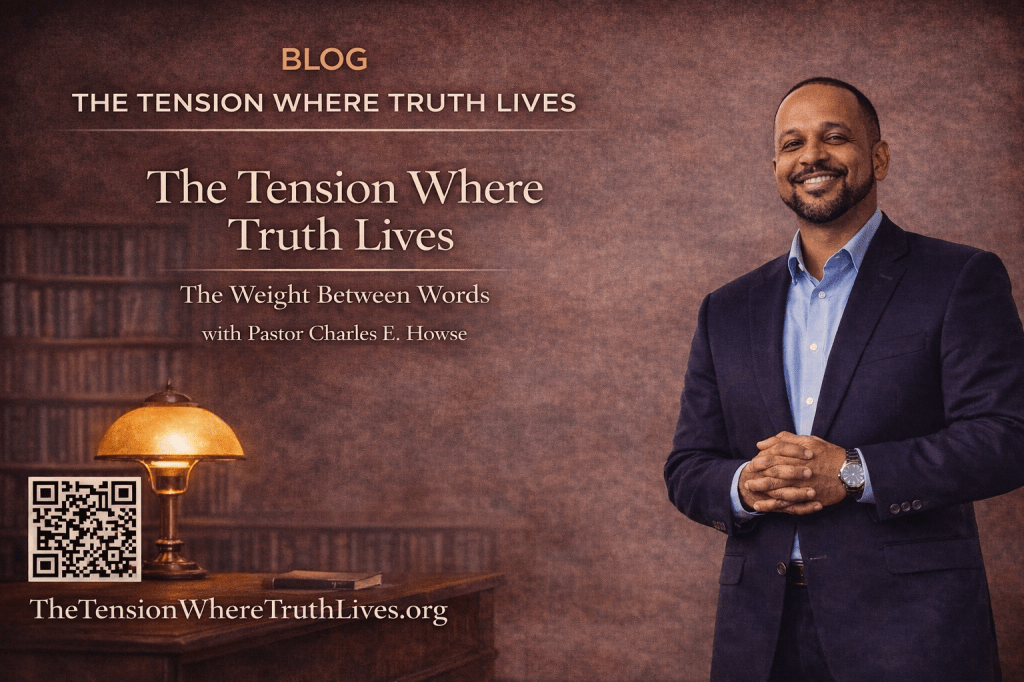
Pastor Charles E. Howse Jr. is a preacher, pastor, and author whose calling lives at the intersection of proclamation and reflection. With decades of ministry experience, he has spent his life speaking to the visible struggles of people while gently naming the quieter battles they carry within. His voice is shaped by Scripture, lived experience, and a deep pastoral concern for those navigating faith, failure, leadership, and the long work of healing. Whether from the pulpit or the page, his work consistently points readers and listeners back to the grace of God that meets us where we truly are. Through writing, Pastor Howse explores the tension where truth lives—the space between certainty and doubt, strength and vulnerability, public faith and private wrestlings. His reflections draw from biblical narratives, personal insight, and pastoral observation, inviting readers to slow down,and think deeply. He writes not to perform, but to bear witness—to grace that restores, love that endures, and a God who remains faithful even when we falter. This blog is an extension of that calling: honest, thoughtful, and rooted in the hope that truth still heals.
 The Tension Where Truth Lives
Leave a comment