I started preaching formally when I was seventeen years old.
As I look back now, I realize I may have been approaching my entire life.
I’m fifty-seven today… which means this year marks forty years of preaching.
That sentence still feels strange to say out loud.
For most of my life, my calling was expressed through declaration. I preached with very few notes… sometimes just an outline… often just conviction. I’ve always been a contemporaneous preacher — trusting the moment, the movement, the Spirit.
Writing was never part of my self-image.
Truth be told, I never enjoyed reading much… not even when I was young. If you had asked me at any point in my early ministry whether I saw myself as a writer, the answer would have been a clear no.
And yet… here I am.
I’ve written two books now. Both are published.
Still, I hesitate to call myself a writer.
Lately, I’ve come to believe that the calling of my life lives somewhere between declaration and writing. I don’t fully understand it yet, but I can’t escape it either.
There is a yearning I haven’t been able to shake.
A Moment That Still Speaks
In my early twenties, I encountered a group of charismatic white Christians who were genuinely kind to me. They invested in me. Encouraged me. They even paid for me to attend a large men’s gathering that was popular at the time called Promise Keepers.
The stated mission was reconciliation — restoring men to their place in God… walking in integrity… confronting past conflicts… learning how to say “I’m sorry” and ask for forgiveness when necessary.
Then came the day of the O.J. verdict.
The nation was on edge. Emotions were raw.
And right after the verdict was announced, I ran into one of the men who had been so kind to me.
In a moment charged with emotion, he said to me,
“That’s the problem with you people…”
I stopped him immediately.
“You people? What do you mean you people?”
What followed was a tantrum — not reasoned, not measured — just raw reaction.
I know now that his words were shaped by fear, emotion, and the cultural weight of that moment. But even then, as a young preacher, something in me recognized what I was witnessing.
It wasn’t just his issue.
It was something deeply rooted.
What Revival Doesn’t Always Reach
Here’s the realization that has stayed with me for decades:
All the conferences in the world…
All the altar calls…
All the reconciliation language…
They cannot, by themselves, uproot what has been formed in the spirit, the soul, and the psyche generation after generation.
That moment taught me something theology alone could not.
Some things require more than inspiration —
they require interrogation.
Some formations survive worship services untouched.
Why I’m Writing Now
I don’t know if writing is relevant in the way preaching is.
I don’t know if my writing has been effective.
I don’t even know if this is what I imagined my later years of ministry would look like.
What I do know is this:
I carry a perspective… a discernment… that needs language.
Technology has finally given me tools to express what I’ve always spoken — without forcing me to become someone I’m not.
That’s why I’m writing this at nearly five in the morning.
Not to build a platform.
Not to argue.
But to leave a record.
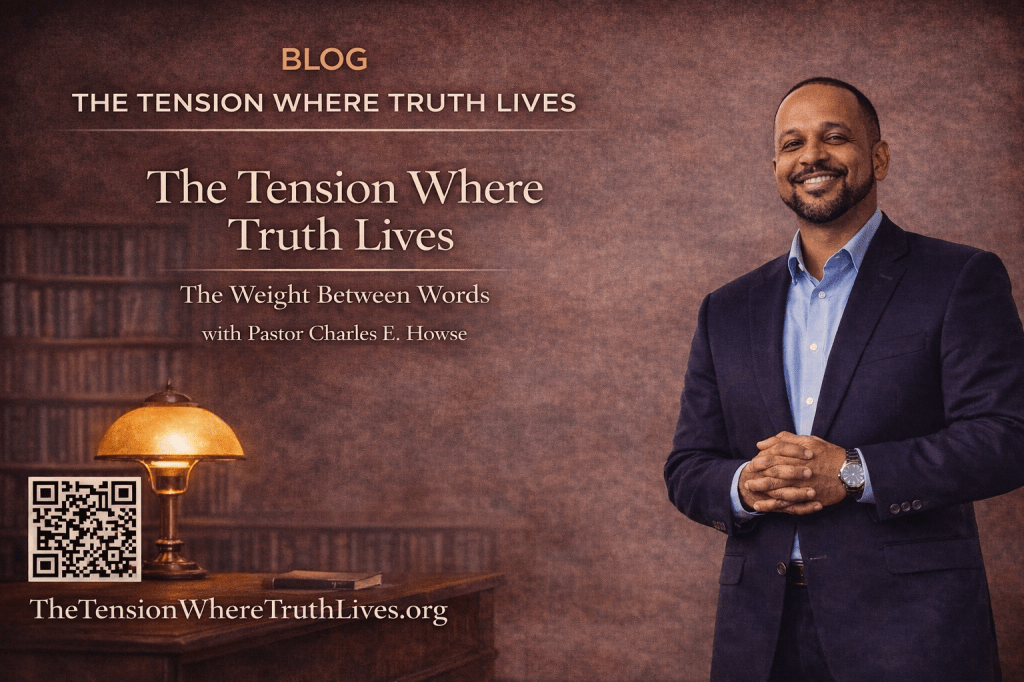
This blog is my attempt to stand honestly between the pulpit and the page — and invite you into the conversation.
If you’ve ever felt the tension between what we say and what we’re willing to confront…
If you’ve ever wondered why some truths linger long after the service ends…
You’re not alone.
This is where I’ll be exploring those questions — slowly, thoughtfully, and truthfully.
— Pastor Charles Howse Jr.
 The Tension Where Truth Lives
Leave a comment